 ultimate-guide
Kitchen Remodel Cost Breakdown 2026
Table of Contents
- Kitchen Remodel Cost Breakdown by Project Scope
- Line Item Cost Breakdown: Cabinets, Countertops, Flooring, and Appliances
- Kitchen Remodel Timeline and Phases
- High-End Kitchen Appliance Cost 2026
- Kitchen Remodeling Permitting Process and Hidden Costs
- Labor vs. Material Costs and Budget Allocation Strategies
- Ways to Save Money Without Sacrificing Quality
- Financing Options and Managing Remodel Costs
- Frequently Asked Questions
Last Updated: September 30, 2026
Kitchen Remodel Cost Breakdown by Project Scope
A kitchen remodel cost breakdown 2026 varies dramatically based on project scope, from surface refreshes to complete gut renovations. Understanding these tiers helps you align expectations with your budget before signing a contract.
Minor remodels refresh finishes without structural changes. Mid-range projects update cabinets and countertops. Upscale kitchens involve complete system replacement, custom cabinetry, high-end appliances, and structural modifications.
A minor refresh takes 4-6 weeks; a gut renovation stretches 12-16 weeks when permitting and inspections are factored in. The kitchen remodel cost breakdown 2026 reflects these realities.
Line Item Cost Breakdown: Cabinets, Countertops, Flooring, and Appliances
Cabinet selection drives the kitchen remodel cost breakdown more than any other line item. Stock cabinets offer the lowest price and fastest delivery. Semi-custom cabinets balance lead time and customization. Full custom cabinetry takes 8-12 weeks but matches your exact specifications.
Countertop fabrication is the second-largest expense. Laminate costs less but shows wear faster. Solid surface materials offer mid-range durability. Natural stone commands premium pricing due to fabrication complexity. Quartz has become popular because it resists staining and requires no sealing.
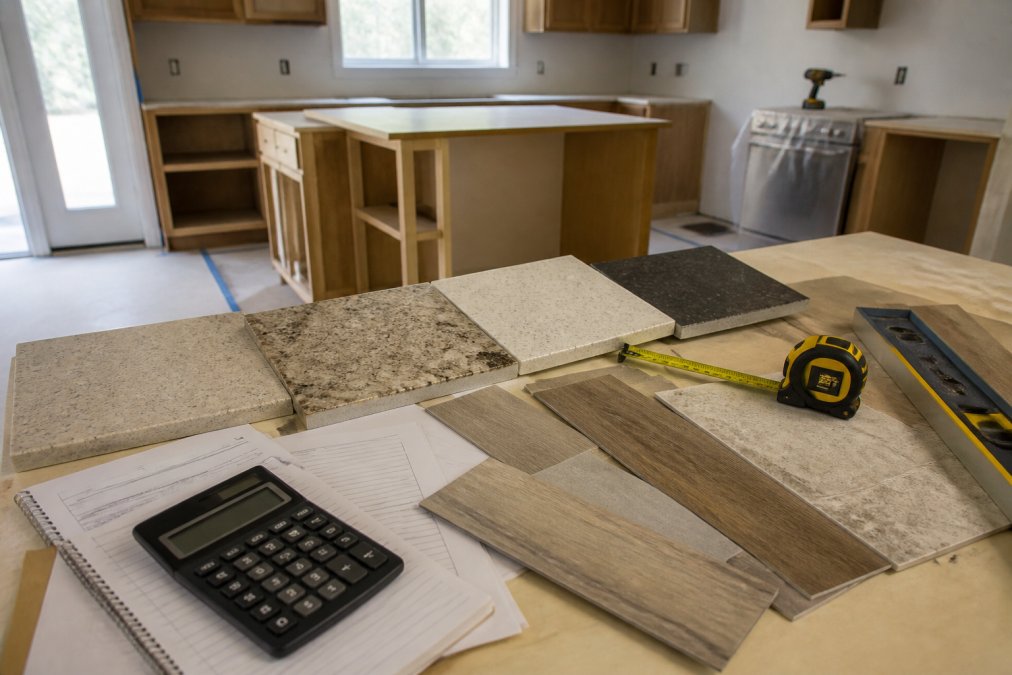
Flooring costs depend on material and subfloor condition. Vinyl plank installs quickly and costs less. Ceramic tile requires more labor. Hardwood demands subfloor preparation. Existing floor damage or uneven spots require subfloor repair, a hidden cost that surprises many homeowners.
High-end appliances represent a significant portion of upscale remodels. Budget packages cost less but may require earlier replacement. Mid-range appliances balance performance and longevity. Professional-grade equipment demands proper ventilation and electrical infrastructure.
Kitchen Remodel Timeline and Phases
The kitchen remodel timeline 2026 depends on project scope, permit approval, and material lead times. Minor refreshes complete in 4-8 weeks. Mid-range projects run 8-12 weeks. Gut renovations extend 12-16 weeks or longer.
Phase one involves demolition and site preparation. Contractors remove existing cabinets, countertops, flooring, and fixtures. Hazardous material removal (asbestos, lead paint) adds time and cost if discovered. Structural assessment reveals framing repair needs.
Phase two covers rough-in work: plumbing relocation, electrical upgrades, and HVAC adjustments. Building permits require inspection checkpoints here. Delays often occur when inspectors identify code violations requiring correction.
Phase three involves cabinet, countertop, flooring, and appliance installation. Lead times for custom cabinetry and special-order appliances directly impact this phase duration.
Phase four covers finishing: backsplash installation, lighting fixtures, hardware, paint, and final trim work. This phase typically takes 2-3 weeks.
High-End Kitchen Appliance Cost 2026
High-end kitchen appliance cost 2026 reflects both performance capabilities and brand positioning, but increasingly includes energy efficiency ratings and smart-home integration features that add significant cost premiums.
Professional-Grade Cooking Equipment: Dual-fuel ranges cost $3,500-$8,000. Induction cooktops cost $2,000-$6,000 but often require electrical panel upgrades ($1,500-$4,000) to handle 240V demand, inflating total cooking system cost.
Refrigeration Systems: Standard stainless steel refrigerators cost $1,500-$3,000. Built-in models with smart features range $4,000-$8,000. French-door models with dual compressors add $1,000-$2,500. Smart refrigerators require reliable Wi-Fi and ongoing software support.
Energy Efficiency Premiums: ENERGY STAR-certified appliances cost 10-25% more but reduce utility costs by 10-50% over their lifespan. For a $6,000 appliance package, ENERGY STAR upgrades add $600-$1,500 upfront but save $50-$100 annually, paying for itself over 15 years.
Smart Appliance Integration: Wi-Fi-enabled appliances cost 15-30% more than non-smart equivalents. A smart oven costs $1,000-$2,000 more than standard models. Smart appliances require stable Wi-Fi, contractor familiarity, and ongoing updates. Not all contractors are trained to install them, potentially requiring specialized technician fees ($150-$300 per call).
Ventilation Systems: Professional-grade range hoods with makeup air handling cost $2,000-$6,000 installed. Downdraft systems cost $1,500-$4,000. Inadequate ventilation creates odors, moisture problems, and voided warranties. Many homeowners underestimate ventilation costs, which can add $3,000-$5,000 to total kitchen cost.
Dishwashers and Specialty Appliances: High-end dishwashers cost $1,200-$2,500. Beverage coolers or wine refrigerators add $800-$3,000 each. Microwave drawers cost $1,500-$3,000 and require precise cabinet planning.
Finish Coordination and Lead Times: Matching appliance finishes creates cohesive design but affects cost and availability. Black stainless and bronze finishes carry 5-15% premiums and require 6-10 week lead times. Unplanned mismatched finishes reduce perceived kitchen quality.
Lead Time Impact on Labor Costs: Custom appliances with 6-12 week lead times create scheduling challenges. A 2-week delay on a $50,000 project can add $3,000-$5,000 in labor costs. Ordering early and coordinating delivery prevents hidden expenses.
Kitchen Remodeling Permitting Process and Hidden Costs
Building permits are required for kitchen remodels involving electrical, plumbing, or structural changes (Consumer Safety). Permit costs typically range from $500 to $2,500 depending on project scope and local fee structures, or 1-3% of total remodel cost.
Soft costs, permits, inspections, engineering, and project management, often represent 10-20% of total kitchen remodel budget but receive minimal attention during initial planning.
Permit and Inspection Fees: Building permit ($300-$1,500), electrical permit ($150-$500), plumbing permit ($150-$500), and mechanical permit ($150-$400). Re-inspection fees ($75-$300) apply if code violations are found.
Engineering and Plan Review: Structural modifications or load-bearing wall removal require a licensed engineer's stamp, costing $500-$2,000. Building department plan review costs $200-$800.
Hazardous Material Abatement: Asbestos removal averages $1,500-$5,000. Lead paint abatement (common in pre-1978 homes) ranges $2,000-$10,000. These unpredictable costs are a primary source of budget overruns.
Structural Repairs: Rotted subflooring, inadequate framing, or moisture damage discovered during demolition demands correction before proceeding. Subfloor replacement costs $800-$2,500. Framing repairs or reinforcement add $1,000-$3,000 depending on extent. These issues often emerge only after walls are opened, making contingency reserves essential.
Electrical Panel Upgrades: If your home's electrical panel cannot handle upgraded kitchen loads (new appliances, additional circuits, 240V lines for induction cooktops), panel upgrade costs $1,500-$4,000. This is particularly common in older homes with 100-amp service.
Inspection Delays and Rework: When work doesn't meet code requirements, re-inspection fees apply and rework delays the project.
Contingency Planning: Reserve 10-15% of your total budget for unexpected issues discovered during demolition or inspection. For a $50,000 remodel, this means $5,000-$7,500 set aside. For a $100,000 remodel, $10,000-$15,000. This buffer prevents project stalls when problems emerge and allows you to address issues without financing delays or cutting corners on quality.
Labor vs. Material Costs and Budget Allocation Strategies
Labor typically represents 40-50% of total kitchen remodel cost, with materials comprising the remaining 50-60%. This ratio shifts based on project complexity. A simple cabinet and countertop refresh skews more toward materials. A gut renovation with structural changes, plumbing relocation, and electrical upgrades increases labor percentage.
Ways to Save Money Without Sacrificing Quality
Keeping existing cabinets while refinishing or repainting them saves dramatically compared to replacement. Cabinet refacing, replacing doors and drawer fronts while keeping the box, offers middle-ground savings. This approach works well if your cabinet layout and structure are sound.
Financing Options and Managing Remodel Costs
Home equity lines of credit (HELOC) offer flexible borrowing against your home's equity. Interest rates on HELOCs are typically lower than personal loans because they're secured by your property. However, your home serves as collateral, creating risk if you can't repay.
Frequently Asked Questions
What is the 30% rule in kitchen remodeling?
The 30% rule suggests spending approximately 30% of your home's value on a kitchen remodel to maintain good return on investment. For a home worth $400,000, that would be roughly $120,000. However, this is a guideline, not a requirement. Your actual kitchen remodel cost depends on your specific goals, desired finishes, and local labor rates. Luxury kitchens often exceed this threshold when homeowners prioritize quality and custom features over resale value.
What is the most expensive part of a kitchen remodel?
Cabinetry typically represents the largest single expense in a kitchen remodel, often accounting for 30-40% of the total budget. Custom or semi-custom cabinets, fabrication, and professional installation drive these costs higher than stock options. Countertops, appliances, and labor for plumbing and electrical work follow closely. High-end kitchen appliance costs have risen significantly in 2026, making the appliance package another major line item, especially for luxury remodels with integrated smart-home features.
Is $30,000 enough for a kitchen remodel?
A $30,000 budget works for a minor to mid-range kitchen remodel, typically covering basic cabinet refacing, new countertops, updated appliances, and flooring. However, it limits options for custom cabinetry, premium finishes, and extensive plumbing or electrical relocations. For a gut renovation or upscale kitchen with high-end appliances and custom details, $30,000 falls short. Your actual budget should align with your project scope and the specific upgrades that matter most to you.
How do permitting and engineering fees impact kitchen remodel costs?
Permitting and engineering fees vary by location and project complexity but typically range from $500 to $3,000 for a kitchen remodel. Structural changes, plumbing relocations, electrical upgrades, and HVAC adjustments trigger higher permit costs and longer approval timelines. These soft costs are often overlooked in initial budget estimates but are essential for code compliance and final inspections. Working with an experienced contractor who manages the kitchen remodeling permitting process ensures you avoid delays and unexpected compliance issues.
What hidden costs should I plan for in a kitchen remodel?
Common hidden costs include asbestos or mold remediation, structural repairs discovered during demolition, plumbing and electrical upgrades beyond the original scope, gas line relocation, HVAC modifications, and disposal of demolition waste. A contingency fund of 10-20% of your total budget protects against these surprises. Supply chain delays and lead times for custom cabinetry or appliances can also extend timelines and increase costs. Transparent communication with your contractor about potential soft costs and contingency planning prevents budget overruns.