 blog
Is Hiring a Public Adjuster Worth It? 7 Factors to Weigh
Quick Summary
A public adjuster is worth hiring when your claim is large, complicated, or disputed, because their negotiating help can recover more than the percentage fee costs you. Run the break-even math with your own numbers before you sign, since small or simple claims may not justify the fee.
- Compare the fee against the projected gain; if the gain is smaller than the fee, hiring one is not worth it.
- Ask whether the fee applies to the full settlement or only the increase over the insurer's original offer.
- Hire before you sign a proof of loss or deposit a settlement check, since those steps weaken your position.
- Read the termination clause and confirm the fee cap matches your state's statutory limit before signing.
- Roof and storm claims with large estimates or denied damage are where a public adjuster usually pays off most.
Table of Contents
- What a Public Adjuster Does and Who Pays Them
- Public Adjuster Pros and Cons
- Public Adjuster Fees and What They Mean for Your Payout
- When to Hire a Public Adjuster
- Public Adjuster for Roof Claim: Does It Pay Off?
- Timing, Contracts, and Lender Issues to Check Before You Sign
- Scheduling Your Roof or Storm Damage Assessment with LRI Restorations
- Frequently Asked Questions
What a Public Adjuster Does and Who Pays Them
Last Updated: November 4, 2026
A public adjuster works for you, the policyholder, not the insurance company.
Public adjusters are licensed professionals. Requirements vary by state, so check your state's insurance department before you hire anyone. Florida, for example, regulates public adjusters through its own licensing rules.
Who pays them? You do. Public adjusters are typically paid a percentage of the final claim payment, which is the fee structure most people encounter.
- They inspect the damage and write the estimate
- They negotiate with the insurance company
- They handle paperwork and deadlines
Public Adjuster Pros and Cons
Hiring a public adjuster is a trade-off. You gain expertise and time, but you give up a share of the payout.
The main advantages:
- Claim knowledge. They know how adjusters value damage and what to push back on.
- Time savings. They handle calls, documentation, and follow-up.
- Advocacy. They argue for your side when an initial offer looks low.
The main drawbacks:
- The fee. It reduces what you keep, even when they add real value.
- Quality varies. Not every adjuster is experienced or trustworthy, so vet them carefully.
- Limited value on simple claims. A small, straightforward claim may not justify the cost.
Some policyholders on Reddit and in adjuster forums argue that a public adjuster adds little to a typical claim. That view is worth considering, though it reflects anecdote rather than measured data.
Public Adjuster Fees and What They Mean for Your Payout
Public adjuster fees are usually a percentage of the settlement, and that percentage is negotiable in many cases. Ask for the fee in writing before you sign anything.
The fee structures you will actually see
- Contingency fee (most common). A percentage of the final settlement, paid only if money is recovered. Percentages vary by contract, so ask for the specific figure in writing before you sign.
- Sliding scale. The percentage steps down as the settlement grows. A contract might pay 20 percent on the first $100,000 and 10 percent on amounts above that. This structure protects you on large losses and is worth asking for.
- Hourly or flat fee. Less common on property claims but used for consulting, appraisal support, or small disputed items. You pay whether or not the settlement increases, so the risk shifts to you.
The break-even math
Suppose your insurer offers $30,000 and a public adjuster negotiates a $35,000 settlement. At a 10 percent fee on the full settlement, you pay $3,500 and keep $31,500, a $1,500 gain over the original offer.
A second calculation matters just as much. If the adjuster charges on the increase only, the same $5,000 gain at 15 percent costs $750, and you keep $34,250.
Fee caps and statutory limits
Some states limit public adjuster fees by statute. Because these limits are set at the state level and change over time, confirm the current rules with your state's department of insurance before you sign.
Watch out: some contracts apply the percentage to the gross settlement including recoveries for additional living expenses, code-upgrade coverage, or contents, line items the adjuster may not have worked on.
Questions to ask before you sign
- Is the fee a percentage of the full settlement or only the increase over the insurer's offer?
- Is there a minimum fee, and how does it apply if the claim is small?
- Is there a cap, and does it match your state's statutory limit?
Before you commit, ask for a written estimate of what you expect to recover so you can compare the fee against the likely gain. If your claim has already been denied, you can learn how to challenge a denied storm insurance claim step by step before you commit to representation.
The article breaks down the main fee structures and what each one means for what you keep.
| Fee structure | How it works | Policyholder note |
|---|---|---|
| Contingency fee | Percentage of final settlement, paid only if money is recovered | Ask for the specific figure in writing |
| Sliding scale | Percentage steps down as settlement grows | Protects you on large losses |
| Hourly or flat fee | Paid whether or not settlement increases | Risk shifts to you |
| Fee on the increase only | Percentage applies only above insurer's original offer | Most policyholder-friendly structure |
When to Hire a Public Adjuster
A public adjuster tends to pay off when the claim is large, complicated, or in dispute. The more money and detail involved, the more useful their expertise becomes.
Claims Where a Public Adjuster Usually Helps Most
- Large losses from hurricanes or major storms
- Claims where the insurer denied part of the damage
- Hidden damage that requires detailed documentation
Situations Where You Can Likely Skip One
- Minor damage with a clear, quick settlement
- Claims where the insurer's offer already matches your own contractor's estimate
- Situations where you have the time and comfort to handle the process yourself
If you're unsure, a free consultation can help you decide. Many homeowners start by learning how to fight a denied insurance claim on their own, which can show whether professional help is needed.
Public Adjuster for Roof Claim: Does It Pay Off?
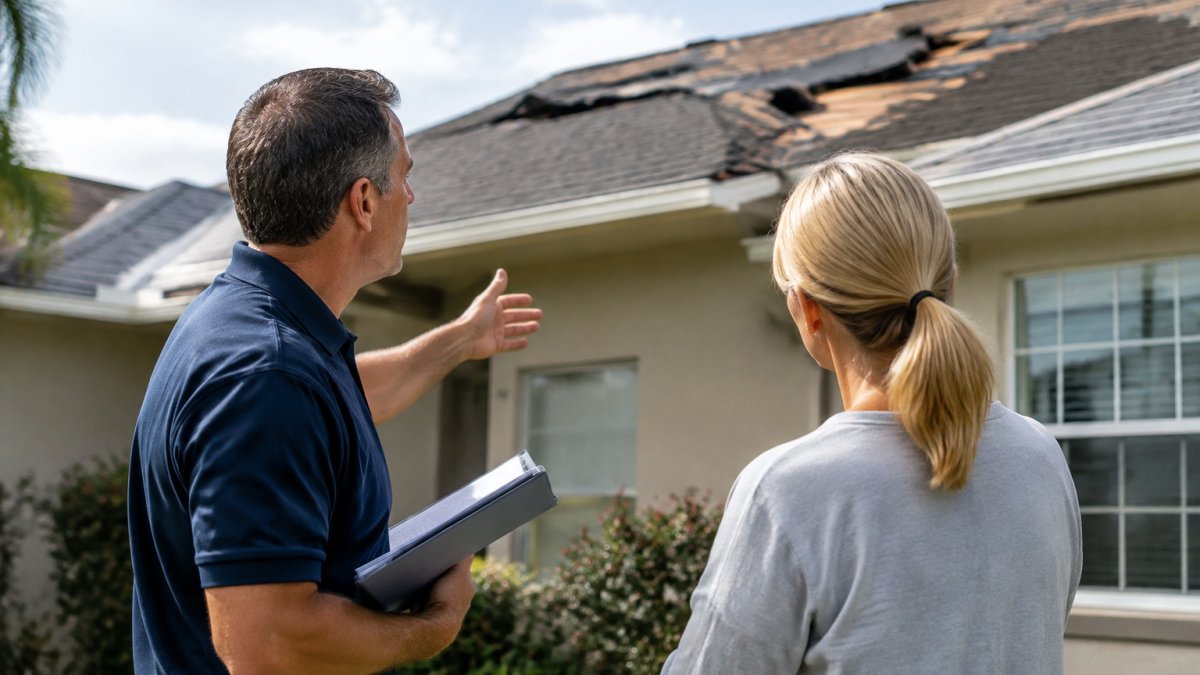
Roof claims are one of the most common uses for a public adjuster. Storm-damaged roofs often hide problems that aren't visible from the ground, such as lifted shingles, water intrusion, or damaged decking.

Roof damage also tends to produce large estimates, so even a modest percentage increase can mean thousands of dollars. Before deciding, check for hidden storm damage on your roof so you know what you're dealing with.
Timing matters too. Steps to take after hurricane roof damage can help you protect your claim and avoid costly delays.
Timing, Contracts, and Lender Issues to Check Before You Sign
Most guides tell you to read the contract. Few tell you what to look for, when it becomes too late to hire an adjuster, or how the mortgage company will treat the check. Those three issues decide whether hiring a public adjuster is worth it far more often than the fee percentage does.
The point of no return: when it is too late to hire one
The claims lifecycle has hard edges, and missing them can make an adjuster useless no matter how good they are.
- Before you sign a proof of loss. Once you sign and submit a sworn proof of loss, you have generally committed to a stated amount. An adjuster can still supplement, but the leverage is lower. The best window is before that signature.
- Before you cash or endorse a settlement check. Cashing a check can be treated as acceptance of the offer. If you are considering an adjuster, do not deposit the check until you have decided.
- Before the policy's suit-limitation deadline. Most policies set a contractual deadline to file suit, and some states shorten or extend it. An adjuster cannot revive a claim after that date passes.
A common pattern is that policyholders call an adjuster after a denial, which is workable, but the strongest position is before the first offer is accepted. If your claim is already denied, learn how to challenge it step by step before the window closes.
Contract terms that decide whether you can walk away
Read the contract for these specific terms, not just the fee:
- Termination and cancellation clause. Ask in writing how you can end the relationship and what you owe if you do. Some contracts make cancellation costly or require the adjuster's consent, which can trap you with an underperformer.
- Scope of representation. Confirm the contract covers the claim you actually have, dwelling, contents, additional living expenses, and any supplement, and not just the roof.
- Fee base and cap. Confirm whether the percentage applies to the full settlement or the increase, and whether a state cap applies.
Watch out: a contract that grants the adjuster authority to endorse checks or settle without your written approval is a red flag. You should retain final approval over any settlement.
How the mortgage company fits in
If you have a mortgage, the lender is usually listed as a co-payee on property damage checks, and most mortgage servicers require the check to be endorsed by both parties. That changes the cash flow, not the claim itself.
- Co-payee endorsement. The check may need your signature and the lender's. Ask your adjuster how they handle this so there are no surprises when the money arrives.
- Escrow and disbursement schedules. Many servicers hold the funds in escrow and release them in draws as work is completed and inspected. Your adjuster should know the servicer's draw schedule and build the repair timeline around it.
- Loss draft department. Large servicers have a loss draft department that reviews the claim and the contractor's documentation. Delays there are common and are not the insurer's fault, so plan for them.
- Mortgagee clause. Your policy names the lender as mortgagee, which means the lender has rights to the proceeds. Confirm the adjuster has worked with mortgagee-clause claims before.
A short pre-signing checklist
- Confirm the adjuster's license with your state's department of insurance.
- Get the fee base, cap, and minimum in writing.
- Get the termination clause in writing.
- Confirm the suit-limitation deadline on your policy.
Finally, don't wait too long. Insurance policies set deadlines for filing and supplementing claims, and missing them can hurt your recovery.
Scheduling Your Roof or Storm Damage Assessment with LRI Restorations
If you're weighing whether a public adjuster is worth the cost, start with an accurate picture of the damage. At LRI Restorations, we're a family-owned and operated company, and we specialize in navigating insurance claims on Florida's Gulf Coast.
To get a clear assessment of your roof or storm damage, schedule your assessment with LRI Restorations and get the documentation you need before you decide on next steps.
Frequently Asked Questions
What is the downside of using a public adjuster?
The main downside is cost. A public adjuster typically takes a percentage of the claim payout, so you keep less of the settlement. On a small or straightforward claim, that fee can outweigh any extra money the adjuster recovers. Some adjusters also take longer than expected, and a poor-quality adjuster can damage the relationship with your insurer or miss deadlines. Ask for the fee in writing, confirm the contract terms, and check whether you can cancel before signing.
Are public adjusters worth the cost?
They can be, mainly when the claim is large, complex, or disputed. A public adjuster may document damage more thoroughly and push back on an undervalued estimate. For a simple claim the insurer has already accepted at a fair number, the fee may not be justified. Compare the adjuster's percentage against your likely gain from a higher settlement, then decide. Requesting a written estimate of both the fee and the expected increase makes the comparison concrete.
What is the average fee for a public adjuster?
Fees are usually a percentage of the insurance settlement, and they vary by state, claim type, and contract. Common structures include a flat percentage of the final payout. Because these numbers depend on the claim, avoid relying on a single average. Ask any adjuster for their fee schedule up front, and confirm whether the percentage applies to the amount you receive or to the amount the insurer initially offered.
Should I hire a public adjuster for a roof claim?
A roof claim is a common reason to consider one, especially after a major storm when the insurer's estimate covers only part of the repairs. Roof damage can be hard to scope, and disputes over shingles, decking, and code upgrades are frequent. If your insurer has denied or undervalued the roof portion, a public adjuster may help. If the claim is minor and the estimate is reasonable, you may be able to handle it with a licensed roofing contractor's documented assessment.